

I just finished reading The Age of Innocence by Edith Wharton (1920) and a small detail stood out to me: the main characters were going to get married on the Tuesday after Easter.
Tuesday? Why Tuesday? Since the book was set in the 1870s, was Tuesday a typical day to get married? Why not Saturday?
So I began thinking about my own family tree. I got married on a Saturday, my folks got married on a Saturday, so I assumed that all of my ancestors did.
I need to look at the data to break up any assumptions!
What I decided to do was to go back five generations (including myself) to see how this all plays out. I did include my ancestors who were in Norway and Sweden since their children were my most recent immigrants.
My results were interesting (the light green letters on the side are coding for me to keep track of which branch I recording):
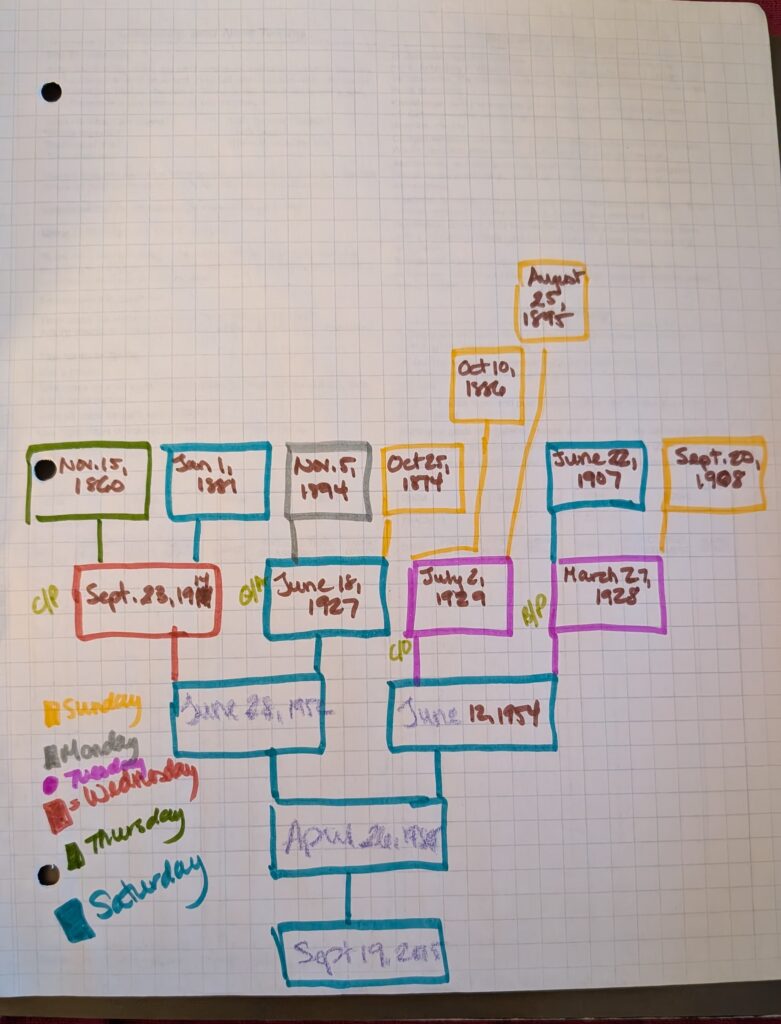
While yes, the majority of the 16 marriages I recorded were on Saturdays, Sundays were also popular.
But this is just the first step. The next step is to ask the data and facts more questions, such as:
– What months were the most common?
– What ages were the couple when they married?
– How did this play into their careers (farming play a part?)
– Any weddings that were less than 9 months away from their first-born?
– Proximity to officiant and how easy it was to travel
– Church weddings versus Justice of the Peace
– Historical events that were happening during the time of the wedding (I.e. Chernobyl, Stock Mark Crash)
– Any weddings that have the same date, different year (we were married on the same day as one of my husband’s ancestors)
Speaking of my husband, I decided to do his tree, too. While my ancestors were mainly in Minnesota and Western Wisconsin, his family was in Central and Eastern Wisconsin (minus one U.P.-er) and his results were different enough.
To respect his family’s privacy, I will only include a couple of takeaways:
— He had two couples that were married on holidays
— The couples in his family were primarily married on Saturday, the second popular day of the week was Thursday
This was a lot of fun to track, ponder over, and definitely something I want to investigate more. Maybe a future presentation could be built out of this whole discovery?